
Managing ADHD with Gracie Barra Jiu Jitsu Thousand Oaks: Success Stories from Newbury Park
For parents in Newbury Park and the greater Conejo Valley, managing a child’s (or adult’s) ADHD often involves a complex mix of medication, therapy, and endless searches for the “right” extracurricular activity.

While team sports like soccer or baseball often lead to frustration—due to the “standing around” time or complex social dynamics—Gracie Barra Thousand Oaks (GBTO) has emerged as a surprising and highly effective sanctuary for neurodivergent minds.
Inside the Sports Academy, under the guidance of Professor Gabriel Arges, the mat has become a place where “deficits” in attention are transformed into “superpowers” of hyper-focus. Here is a detailed look at how GBTO manages ADHD and the success stories emerging from the Newbury Park mats.
- The Science: Why the ADHD Brain Craves Jiu-Jitsu
Standard exercise produces endorphins, but Brazilian Jiu-Jitsu (BJJ) produces dopamine and norepinephrine—the exact neurotransmitters that ADHD brains are often starving for.
“Chess with Your Body”: ADHD brains struggle with boredom but thrive on complex problem-solving. BJJ is not repetitive like running on a treadmill; it is an infinite puzzle of leverage, weight distribution, and escape angles.
The “Survival” Focus: When a training partner is trying to pass your guard or pin you down, your brain cannot wander to homework or video games. The immediate physical consequence (getting pinned) forces a state of “flow” and absolute presence that many people with ADHD rarely experience elsewhere.
- The Structure: The “Red Shield” Rituals
Children with ADHD often struggle with transitions and unstructured time. The Gracie Barra curriculum provides a rigid, predictable framework that reduces anxiety.
Predictability: Every single class follows the same pattern: Line up -> Bow in -> Warm-up -> Technique -> Drilling -> Sparring -> Bow out. This consistency creates a safe container where the student knows exactly what is expected of them.
Immediate Feedback: In school, a grade comes weeks later. On the mats at GBTO, feedback is instant. If you lose focus during a move, you fall over. This tight feedback loop helps the ADHD brain connect cause and effect much faster than in a classroom.
- The “Gabriel Arges” Effect: Calm in the Storm
A major factor in the success stories at Newbury Park is the temperament of the head instructor.
The Anti-Yelling Approach: Many coaches try to “discipline” ADHD kids by yelling. Professor Gabriel Arges—a 3x World Champion—leads with a quiet, devastatingly calm demeanor.
Mirror Neurons: High-energy kids often spiral when met with high-energy coaching. Arges’s zen-like presence acts as a regulator. Kids unconsciously mimic his calmness, learning to lower their own internal “volume” to match the room.
- Success Archetype 1: The “Classroom Disruptor”
The Struggle: This is the child who can’t sit still in their Newbury Park elementary school class, constantly fidgeting and distracting others.
The GBTO Transformation: On the mats, that boundless energy is an asset, not a liability. In the “Future Champions” program, “fidgeting” becomes “active guard retention.”
The Result: Parents report that after burning intense physical and mental energy at the 4:00 PM class, the child comes home regulated. The “wiggles” are gone, making homework time manageable for the first time. The child learns that there is a time for explosive movement and a time for stillness.
- Success Archetype 2: The “Hyper-Focused” Gamer
The Struggle: The teen who is addicted to video games because they provide constant dopamine hits and clear leveling-up metrics, but has zero interest in physical sports.
The GBTO Transformation: BJJ is a video game in real life. There is a belt system (leveling up). There are specific moves to unlock (learning the Berimbolo or Arges’s Kneebar).
The Result: These students often become the most technical practitioners. Their ability to hyper-focus—often seen as a deficit in school—allows them to obsess over the micro-details of a technique, turning them into “mat scholars” who can out-strategize more athletic opponents.
- Success Archetype 3: The Adult Professional
The Struggle: The successful biotech or business executive in the Conejo Valley who feels their mind is a browser with 50 tabs open, leading to burnout and anxiety.
The GBTO Transformation: For the adult practitioner, the 6:00 PM class is “forced meditation.” You cannot worry about tomorrow’s board meeting when a purple belt is trying to choke you.
The Result: Adults report that BJJ is the only time in their week where their internal monologue shuts off completely. This mental “reboot” allows them to return to their families and high-pressure jobs with a clarity and patience that medication alone often fails to provide.
- The Social Safety Net
ADHD can sometimes lead to social isolation due to missed social cues or impulsive behavior.
The “Crash” Pad: The physical contact of Jiu-Jitsu breaks down barriers. You literally trust your partner with your safety.
Tolerance: The culture at GBTO is incredibly inclusive. Because everyone looks foolish eventually on the mats, there is a high tolerance for quirkiness. A child who is “too much” for the playground is often just “spirited” on the mats, finding a tribe of friends who accept them exactly as they are.
Summary: BJJ as “Vitamin D” for ADHD
Feature of ADHD How GBTO Addresses It
Inattention High-stakes sparring forces 100% focus (“Survival Mode”).
Hyperactivity Intense physical exertion burns off excess energy (“The Wiggles”).
Impulsivity Technical drilling requires waiting and precision (“Pause before moving”).
Rejection Sensitivity Constant small failures (getting tapped) build resilience and thick skin.
Dopamine Deficiency Learning new, complex skills provides a constant reward drip.
In Newbury Park, Gracie Barra is not just teaching these students how to fight; it is teaching them how to drive their own brains. For many families, it has been the missing piece of the puzzle that makes everything else—school, home life, and happiness—fall into place.
Gracie Barra Thousand Oaks represents a unique intersection in the martial arts world: it is a local, family-oriented academy that operates with the facility standards and championship pedigree of a professional athletic training center.
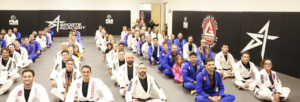
Located inside the renowned Sports Academy (formerly Mamba Sports Academy) in Newbury Park, it offers a distinct “University of Jiu-Jitsu” experience led by one of the most successful active competitors in the sport’s history.
- World-Class Leadership
The primary draw for students—from hobbyists to professional fighters—is the caliber of instruction.
Professor Gabriel Arges: The academy is owned and led by Gabriel Arges, a 3-time IBJJF Black Belt World Champion. In the BJJ world, this is the equivalent of learning basketball from a current NBA All-Star. His leadership ensures that students learn modern, battle-tested techniques rather than outdated methods.
The Romulo Barral Lineage: Arges is a black belt under the legendary Romulo Barral (Gracie Barra Northridge). This connection integrates the academy into a powerhouse regional network, granting students access to elite seminars and high-level training partners from across Southern California.
- A Professional Athlete Facility
Unlike many BJJ schools located in small industrial warehouses, Gracie Barra Thousand Oaks benefits from being housed within a major athletic complex.
The “Pro” Environment: Located at 1011 Rancho Conejo Blvd, the academy is part of a 96,000 sq. ft. facility. It features professional-grade lighting, expansive mat space, and an atmosphere of high-performance athletics.
Hospital-Grade Hygiene: Leveraging the standards of the Sports Academy, the mats are kept to a clinical level of cleanliness (“Red Shield” standard), drastically reducing the risk of skin infections common in lesser-regulated gyms.
Amenities: Students have access to premium changing rooms, showers, and a pro shop, catering to the “Executive” crowd who need to head straight to work after morning training.
- Adult Programs: Structure Meets Intensity
The curriculum is designed to accommodate two distinct groups: the working professional who cannot afford to get injured, and the young athlete chasing gold medals.
GB1 Fundamentals: This is the safe on-ramp for beginners. There is no live sparring in these classes. The focus is on self-defense mechanics, safe falling techniques (breakfalls), and core positional drills. This structure makes BJJ accessible to doctors, executives, and parents in the Conejo Valley.
GB2 & GB3 (Advanced): Once students earn 3 stripes on their white belt, they unlock advanced classes. Here, the focus shifts to the “Arges Style”—dynamic guard play, modern leg locks (like the “Kneebarge”), and the strategic “Physical Chess” required for competition.
Competition Team: Under Arges’s guidance, the competition team is one of the most successful in the region. Intense “comp classes” attract practitioners from Simi Valley, Moorpark, and Camarillo looking to test their limits.
- The “Future Champions” Youth Program
The youth program is a cornerstone of the academy, divided by age to ensure developmental appropriateness.
Anti-Bullying Philosophy: The curriculum teaches children to neutralize bullies without violence. They learn to control an aggressor using leverage and pins (“negotiation from the top”) rather than striking, protecting them from both physical harm and school suspension.
Age-Specific Classes:
Little Champions (Ages 3–6): Focuses on motor coordination, listening skills, and “animal movements” to build body awareness.
Juniors (Ages 7–9): Introduces technical grappling, partner drills, and the concept of leverage.
Teens (Ages 10–15): A critical program for adolescents that combines self-defense with the athleticism of sport BJJ, helping teens navigate social pressure and build a healthy, disciplined peer group.
- Culture and Atmosphere
Despite the elite pedigree of its instructors, the culture is famously “no-ego.”
The “Red Shield” Etiquette: The academy strictly follows traditional martial arts etiquette—bowing onto the mats, addressing instructors as “Professor” or “Coach,” and respecting training partners.
Mentorship: Higher belts (“Big Brothers/Sisters”) are expected to guide and protect lower belts. It is common to see a World Champion competitor helping a Day-One white belt tie their belt.
Family-Centric: The schedule often aligns adult and kids’ classes, allowing parents to train simultaneously with their children.
Gracie Barra Thousand Oaks offers a premium martial arts experience where “World Class” is a reality, not just a slogan. Whether you are a parent seeking confidence for your child or an adult wanting to learn from a living legend, the academy provides a safe, clean, and highly professional environment to start your journey.
Would you like me to find the current class schedule for a specific age group, or would you like directions to the Sports Academy facility? https://gbthousandoaks.com/free-trial/
Gracie Barra Jiu Jitsu & Martial Arts Academy Thousand Oaks CA
1011 Rancho Conejo Blvd, Thousand Oaks, California 91320, United States
Phone Number: +1 805-721-6776
Office Hours
Mon. 09:00 am – 07:30 pm
Tue. 09:00 am – 07:30 pm
Wed. 09:00 am – 07:30 pm
Thu. 09:00 am – 07:30 pm
Fri. 09:00 am – 07:30 pm
Sat. 09:00 am – 07:30 pm
Sun. Closed

Route
Gracie Barra Jiu-Jitsu Thousand Oaks & Martial Arts CA
Secondary phone: +1 805-721-6776

