
Verbal Assertiveness: Teaching Kids to Say “No” in Gracie Barra Jiu Jitsu Thousand Oaks
At Gracie Barra Thousand Oaks (GBTO), self-defense begins long before a physical altercation occurs. Under the guidance of Professor Gabriel Arges, the kids’ program emphasizes that the most powerful weapon a child has is not a chokehold, but their voice.

Many children are socialized to be “polite” and compliant, which can make them vulnerable to bullies and predatory adults. The Verbal Assertiveness curriculum at GBTO is designed to rewire this conditioning, teaching children that they have the right—and the ability—to set boundaries firmly and effectively.
Here is a detailed breakdown of how Gracie Barra Thousand Oaks teaches kids the power of saying “No.”
- The “Stop” Stance: The Physical Anchor
Verbal assertiveness fails if the body language contradicts it. A child looking at their shoes while whispering “stop” signals weakness.
The Frame: Children are taught to adopt a specific “verbal defense stance.”
Hands Up: Palms open, facing out, at chest level. This serves two purposes: it creates a physical barrier (the “fence”) and signals “I do not want to fight,” which is crucial if teachers or witnesses are watching.
The Base: Feet are shoulder-width apart, one leg slightly back. This ensures that if the bully pushes them, they won’t fall over, maintaining their visual dominance.
The Anchor: This physical posture acts as a psychological anchor. When the hands go up, the brain switches into “Defense Mode,” making it easier to find their voice.
- The Three-Part Vocal Drill
GBTO instructors drill the voice just like they drill a hip escape. It is a muscle that needs to be exercised.
Volume vs. Screaming: Children learn the difference between a high-pitched scream (which signals panic) and a deep, projected command (which signals authority). They practice speaking from the diaphragm (“belly voice”).
The Script: To prevent freezing in the moment, children are given a simple, repeatable script:
- “Stop!” (Arresting the behavior).
- “Leave me alone!” (Stating the boundary).
- “Back up!” (Giving a directional command).
Eye Contact: The most difficult part for shy kids is maintaining eye contact. Drills involve staring at the instructor’s forehead or nose (easier than eyes) while delivering the command, ensuring they look confident even if they are scared.
- The “Broken Record” Technique
Bullies often try to argue, insult, or manipulate the victim into engaging (“What, are you scared?”, “You’re a baby”).
The Trap: If a child responds to the insult (“I’m not a baby!”), they have lost control of the interaction.
The Technique: GBTO teaches the “Broken Record” method. No matter what the bully says, the child repeats their boundary.
Bully: “You’re ugly.”
Student: “Stop! Leave me alone.”
Bully: “Why are you acting weird?”
Student: “I said back up. Leave me alone.”
The Result: This bores the bully. Without the “fuel” of an emotional reaction, the bully typically moves on to an easier target.
- Overcoming the “Politeness” Trap
In the Conejo Valley suburbs, many children are raised to be exceptionally polite and deferential to adults. This can be dangerous if a stranger approaches them.
Permission to be Rude: Professor Arges teaches that safety is more important than politeness.
Stranger Drills: The curriculum includes scenarios where an instructor poses as a “friendly stranger” asking for help finding a puppy or offering candy. The child practices stepping back, putting up the “Stop” hand, and yelling “NO! I don’t know you!”
The Outcome: This empowers the child to break social norms when their gut instinct tells them something is wrong, ensuring they don’t get into a car or leave a safe area just to be “nice.”
- Role-Playing in the Safety Lab
Knowing how to say “No” is different from actually doing it under pressure.
The Circle Drill: Children stand in a circle. One student enters the middle. The instructors (or other students acting as bullies) approach them with “mean” energy (safe but intimidating).
Inoculation: The child must use their stance and voice to stop the approach.
Micro-Stress: The first time a shy child does this, they often giggle nervously or whisper.
Correction: The instructor gently corrects them: “I couldn’t hear you. Try again. Make me believe you.”
Success: By the third try, the child is shouting with confidence. The class claps. This positive reinforcement wires the brain to associate assertiveness with success, not fear.
Summary: The Verbal Defense Hierarchy
Stage Action Goal
- Visual Strong Stance, Eye Contact Show confidence; deter the bully before they speak.
- Verbal “Stop! Leave me alone!” Set a clear boundary; alert teachers/adults.
- Physical Clinch | Takedown | Control Last Resort. Only used if the bully attacks physically.
At Gracie Barra Thousand Oaks, the goal is for the child to be so good at Stages 1 and 2 that they never have to use Stage 3. They learn that a confident “No” is the ultimate shield.
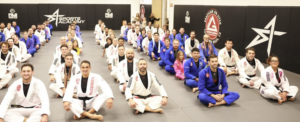
Gracie Barra Thousand Oaks represents a unique intersection in the martial arts world: it is a local, family-oriented academy that operates with the facility standards and championship pedigree of a professional athletic training center.
Located inside the renowned Sports Academy (formerly Mamba Sports Academy) in Newbury Park, it offers a distinct “University of Jiu-Jitsu” experience led by one of the most successful active competitors in the sport’s history.
- World-Class Leadership
The primary draw for students—from hobbyists to professional fighters—is the caliber of instruction.
Professor Gabriel Arges: The academy is owned and led by Gabriel Arges, a 3-time IBJJF Black Belt World Champion. In the BJJ world, this is the equivalent of learning basketball from a current NBA All-Star. His leadership ensures that students learn modern, battle-tested techniques rather than outdated methods.
The Romulo Barral Lineage: Arges is a black belt under the legendary Romulo Barral (Gracie Barra Northridge). This connection integrates the academy into a powerhouse regional network, granting students access to elite seminars and high-level training partners from across Southern California.
- A Professional Athlete Facility
Unlike many BJJ schools located in small industrial warehouses, Gracie Barra Thousand Oaks benefits from being housed within a major athletic complex.
The “Pro” Environment: Located at 1011 Rancho Conejo Blvd, the academy is part of a 96,000 sq. ft. facility. It features professional-grade lighting, expansive mat space, and an atmosphere of high-performance athletics.
Hospital-Grade Hygiene: Leveraging the standards of the Sports Academy, the mats are kept to a clinical level of cleanliness (“Red Shield” standard), drastically reducing the risk of skin infections common in lesser-regulated gyms.
Amenities: Students have access to premium changing rooms, showers, and a pro shop, catering to the “Executive” crowd who need to head straight to work after morning training.
- Adult Programs: Structure Meets Intensity
The curriculum is designed to accommodate two distinct groups: the working professional who cannot afford to get injured, and the young athlete chasing gold medals.
GB1 Fundamentals: This is the safe on-ramp for beginners. There is no live sparring in these classes. The focus is on self-defense mechanics, safe falling techniques (breakfalls), and core positional drills. This structure makes BJJ accessible to doctors, executives, and parents in the Conejo Valley.
GB2 & GB3 (Advanced): Once students earn 3 stripes on their white belt, they unlock advanced classes. Here, the focus shifts to the “Arges Style”—dynamic guard play, modern leg locks (like the “Kneebarge”), and the strategic “Physical Chess” required for competition.
Competition Team: Under Arges’s guidance, the competition team is one of the most successful in the region. Intense “comp classes” attract practitioners from Simi Valley, Moorpark, and Camarillo looking to test their limits.
- The “Future Champions” Youth Program
The youth program is a cornerstone of the academy, divided by age to ensure developmental appropriateness.
Anti-Bullying Philosophy: The curriculum teaches children to neutralize bullies without violence. They learn to control an aggressor using leverage and pins (“negotiation from the top”) rather than striking, protecting them from both physical harm and school suspension.
Age-Specific Classes:
Little Champions (Ages 3–6): Focuses on motor coordination, listening skills, and “animal movements” to build body awareness.
Juniors (Ages 7–9): Introduces technical grappling, partner drills, and the concept of leverage.
Teens (Ages 10–15): A critical program for adolescents that combines self-defense with the athleticism of sport BJJ, helping teens navigate social pressure and build a healthy, disciplined peer group.
- Culture and Atmosphere
Despite the elite pedigree of its instructors, the culture is famously “no-ego.”
The “Red Shield” Etiquette: The academy strictly follows traditional martial arts etiquette—bowing onto the mats, addressing instructors as “Professor” or “Coach,” and respecting training partners.
Mentorship: Higher belts (“Big Brothers/Sisters”) are expected to guide and protect lower belts. It is common to see a World Champion competitor helping a Day-One white belt tie their belt.
Family-Centric: The schedule often aligns adult and kids’ classes, allowing parents to train simultaneously with their children.
Gracie Barra Thousand Oaks offers a premium martial arts experience where “World Class” is a reality, not just a slogan. Whether you are a parent seeking confidence for your child or an adult wanting to learn from a living legend, the academy provides a safe, clean, and highly professional environment to start your journey.
Would you like me to find the current class schedule for a specific age group, or would you like directions to the Sports Academy facility? https://gbthousandoaks.com/free-trial/
Gracie Barra Jiu Jitsu & Martial Arts Academy Thousand Oaks CA
1011 Rancho Conejo Blvd, Thousand Oaks, California 91320, United States
Phone Number: +1 805-721-6776
Office Hours
Mon. 09:00 am – 07:30 pm
Tue. 09:00 am – 07:30 pm
Wed. 09:00 am – 07:30 pm
Thu. 09:00 am – 07:30 pm
Fri. 09:00 am – 07:30 pm
Sat. 09:00 am – 07:30 pm
Sun. Closed

Route
Gracie Barra Jiu-Jitsu Thousand Oaks & Martial Arts CA
Secondary phone: +1 805-721-6776

